Photos of Aboriginal Ceremonies from the Tiwi Islands, Australia

Aboriginal Ceremonies from the Tiwi Islands
Although the Tiwi people of Bathurst and Melville Island have been under the influence of the Catholic Church since the arrival of the missionaries in 1911, they have kept many aspects of their traditional culture, especially their art and crafts and clan dances. Their language, Tiwi, is unique and seems to be unrelated to any other (although there are theories about possible common traits with mainland languages) due to their long isolation. The language is still spoken by all, although it has changed over the years under the influence of English.
you may then send it as a postcard if you wish.
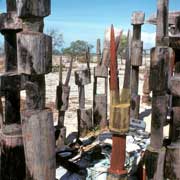
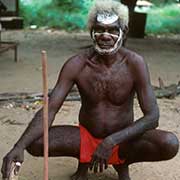
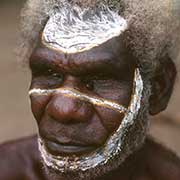
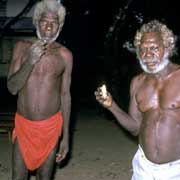
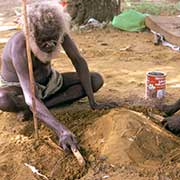
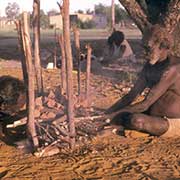
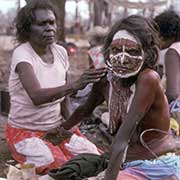
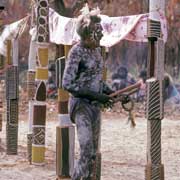
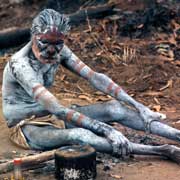
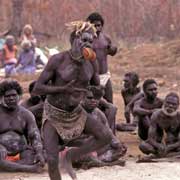
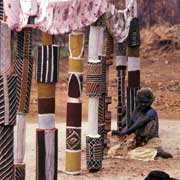
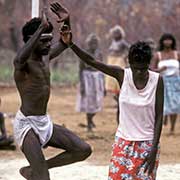
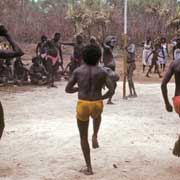
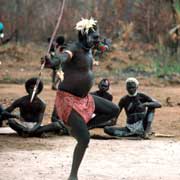
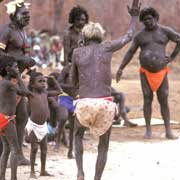
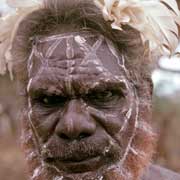
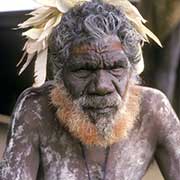
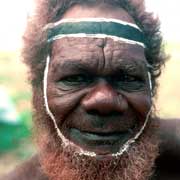
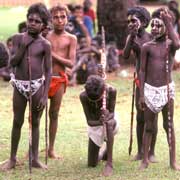
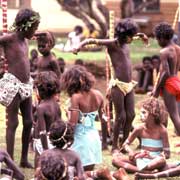
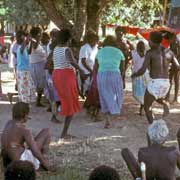
The main traditional Tiwi ceremony is the “Ilaninga” connected with death; it is still performed to a large degree during and after the Christian burial. Carved and painted poles, commissioned by the family, used to be placed around the grave but are nowadays displayed on the site where the funeral dances occur, near the dead person’s house. The place is named “Pukumani”, a term that means something like “taboo”: the name of the deceased person may not be spoken, and their belongings also become “Pukumani”. There is dancing and singing, believed to give guidance and protection for the deceased. While the burial is now a Christian one, those clan a href="../vidnt/index.html">dancess are still done near the grave.
The only other traditional ceremony that is sometimes performed is the “Kurlama” or yam ceremony. It is held at the end of the wet season when a certain kind of yam is harvested, cooked in a specially made earth oven, indicated by sticks placed around it and eaten by the men. Particular songs are sung by men and women, accompanied by tapping sticks at this ceremony. At each interval, there is wailing as people think about the past and relatives who have passed away. In the old days, certain initiation ceremonies for young men and women were also held, but these were abandoned. The women’s ceremony, when she came of age, was relatively short. It took several weeks for boys and was held during the wet season when their elders introduced and indoctrinated them into tribal ways. The Tiwis never practised circumcision, however.
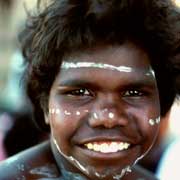
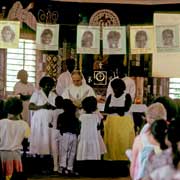
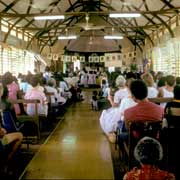
Nowadays, one can argue that these initiation ceremonies have been replaced by the children’s First Holy Communion and, at a later age, Confirmation into the Catholic Church. The children are dressed in new clothes and are decorated with headdresses of cockatoo feathers for boys or woven pandanus rings for girls. Their relatives perform clan dances for them, they are given presents, and it is a very joyous day. Other Christian celebrations are given a distinct Tiwi flavour: at Easter, the children perform the Stations of the Cross, dressed in loincloths, their faces painted; here, too, clan dances are an essential part of the performance.